
My grandfather once said that happiness isn’t a story.
In 1917, two young music students meet at the conservatory – or rather, in a smoke-filled bar crowded with men. They bond over their mutual love for folk music and the history behind it. When they embark on a journey through Maine to collect and archive the music and voices of local people, their relationship deepens into something more – into love, one could say. But gay love in the 1910s isn’t something that can exist beyond hidden doors and empty forests, and so life inevitably intrudes.
I watched Oliver Hermanus‘ tender love story starring Josh O’Connor and Paul Mescal at the International Film Festival Rotterdam. It was 10:30 in the morning when the screening room at De Doelen Theater filled completely. The typical mid-week early morning crowd consisted mostly of people over 60 – part-time workers or retirees – ready to absorb everything like it’s a story told by an old friend. I mention this because – in my opinion – the screening experience matters just as much as the camerawork, the script, or the acting when reviewing a film.
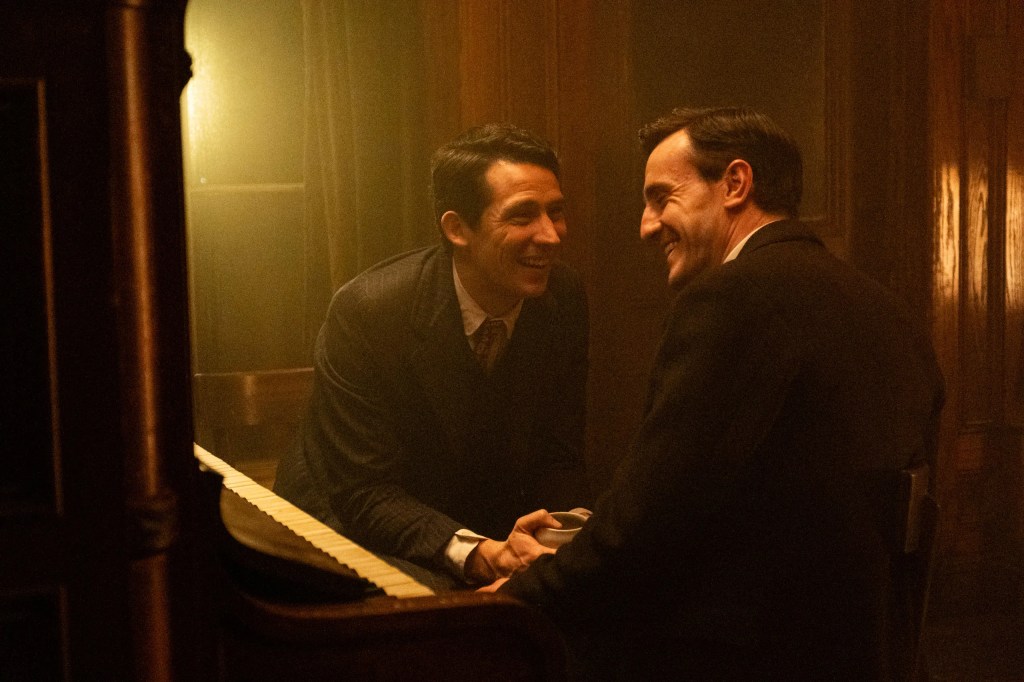
The movie opens, and we’re immediately drawn into the chemistry between Lionel (Paul) and David (Josh). Josh O’Connor has built a career on playing slightly quirky, free-spirited men who’ve seen too much and feel too deeply, and this role is no exception. I realized this during the scene where Lionel and David first meet. Lionel approaches David as he sits at a piano in the murky pub, playing tunes from Lionel’s childhood. When David silences the room so Lionel can sing for him (a moment we’ve all glimpsed in the trailer), the audience erupts into laughter. And I sense that everyone in the screening room is already falling for David. It’s laughter that’s a little too loud, a little too eager – the way you laugh when your crush makes a mediocre joke and you desperately want them to like you. That’s the power of casting. It’s not the script alone that pulls us into David’s orbit; it’s Josh O’Connor’s charisma blazing through the screen.
While many reviews suggest the film lacks deeper insights or dramatic impact, I’d argue the opposite: this film’s power lies precisely in its two main characters and in our own visceral memory of what new love feels like. It felt natural to surrender to the story, to the achingly earnest folk lullabies weaving through the narrative, telling perhaps an even bigger story than the plot itself, and to the radical act of watching two men touch, giggle, and fall in love on the big screen.
Queer cinema has evolved – watching two men fall in love is, thankfully, no longer considered extraordinary. But THE HISTORY OF SOUND offers something different, something that felt new to me. It’s the slow-burn devastation of fading memory, of the stories we construct about our own lives – sometimes distorted, sometimes frozen in amber. It’s no accident that the film’s final scene mirrors one of its opening moments, altered just slightly, almost imperceptibly – but devastating once you realize what’s shifted.
As the film progresses, we come to know Lionel more intimately and understand that we’re witnessing his story, filtered through his memory. This isn’t the „objective moviereality“ many films attempt to present, but rather a deeply subjective recollection. Hermanus creates this through voice-over narration and scenes that feel less like moving images and more like photographs – static, unchanging, preserved (there are multiple moments where we see only Davids back). We become both observers and participants, because we recognize this feeling intimately. When we recall a long-lost love, we’re left with only fragments: silhouettes of moments, physical sensations, perhaps a single photograph seared into memory – but never the complete story, never the unvarnished truth.
In this way, THE HISTORY OF SOUND offers a uniquely intimate experience of exploring not just the history of music, but the history of life itself – how we remember, how we grieve, how we preserve what we’ve loved, and how we tell our own stories. Because in the end, love and life are just that: a story.
 countercuts.com