
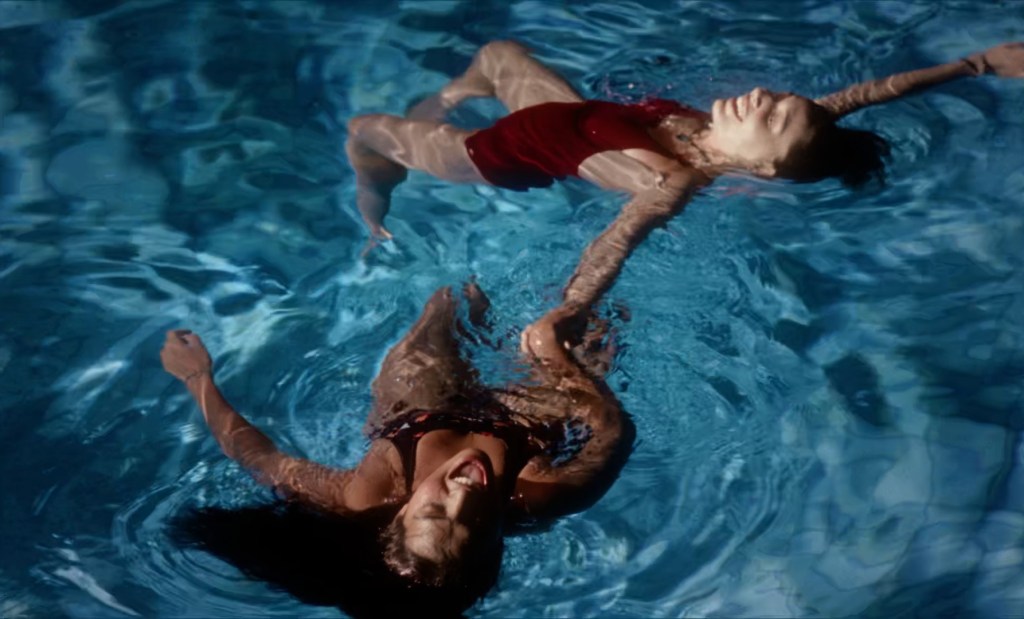
I watched 24 films (A24 would be proud) at Berlinale this year over 8 days. I walked from cinema to cinema through snow and ice and rain, relentlessly focused on the screen. Until this magic thing happened that makes film festivals so special: you find your accidental common thread – a theme, a frame, a topic, a character. Sometimes they’re funny or simply interesting, sometimes scary. This year, my thread made me feel physical pain: abuse. Specifically, assault on female* bodies and sexual violence kept running through the movies I watched. Coincidence or unconscious decision? I surely didn’t go out of my way to find every film on that topic at the festival. But maybe it was something else these films all had in common – ENJOY YOUR STAY, 17, RAGING, WOMEN AS LOVERS and SAD GIRLZ, some more, some less. And this is why I decided to write about one of them today.
SAD GIRLZ not only reminded me of one of my favourite films this year and one of my favourite films on sexual abuse of all time – SORRY, BABY – but I also wish every teenager gets to watch this beautifully written and immaculately produced film about female friendship and trust.
Fernanda Tovar’s feature-length debut had its world premiere in the Generation 14plus section. La Maestra and Paula are two of the best swimmers on their school team – inseparable best friends living in sunny Mexico, who trust each other with the ease of people who have known each other forever. But after a party where Paula and Daniel, her long-time crush, slip into the bathroom together, something shifts. Paula becomes sad and distant, more withdrawn, unfocused. La Maestra gently pushes for answers until Paula finally tells her what happened in that bathroom. Together they try to make sense of it all, try to find words for the indescribable, and respond in very different ways to what they’re feeling. They try to do the right thing but have no idea what that might be. Their choices begin to define them – and to test whether the friendship can hold beyond this.
It goes without saying that SAD GIRLZ depicts something many people in that screening room had already lived through. Let’s do the math. The capacity of Zoo Palast 1, where I watched the film, is 602. Statistically, across the EU, around 55–75% of all women* have experienced sexual harassment in their lifetime; 20–25% have been victims of sexual assault or rape. Combined, around 60–70% of all women* have experienced one or more of these attacks against their bodies. In a screening room with approximately 300 FLINTA* (50%, not unlikely for a film festival like Berlinale), that’s around 200 people sitting around me. I’m not saying this to be provocative. I’m saying it to make legible the significance that comes with depicting sexual assault. This is why I have spent my whole life resenting films about rape of women made by cis men. No amount of research, however long or deep, is enough to understand both the constant fear of being raped and the eerie, mundane normality with which we all carry that fear or the experience through our daily lives. To depict it as spectacle, as a dramatic rupture, as an act of violence interchangeable with any other – that has never worked for me.
So what is different about these films? Both SORRY, BABY and SAD GIRLZ place a friendship between two women at the center of their attention. And as I’ve already laid out, rape, assault and harassment will, sooner or later, become part of that story between friends. It’s this almost mundane givenness of it all that made me feel both films so deeply and physically. What I think everyone who watched these films noticed is the way in which they depict the act itself. While Eva Victor chooses to show the front of the house where it happens from the outside until daylight strikes after an awfully long night shot, Fernanda Tovar shows the door to the bathroom closing and cuts to the next day. What is way more interesting than the assault, in both movies, is the moment the two friends talk about what happened. While SORRY, BABY has the friends, who are far older than Paula and La Maestra, sit in the bathroom so Agnes can take a bath and explain in detail what has happened to her, Paula and La Maestra need a dancing lesson in the park to be able to speak. The comfort of their friend (shoutout to the dance teacher in the park, a person we could all need in our lives), a well-known environment, and the movement of their bodies – it seems to give the characters ease to talk about a horrific thing, but it also gives the scene something beautiful. The two move away from and toward the camera many times – we as viewers move along with them. We listen, we reflect, but we don’t get stuck. We learn about what happened while the characters do. An act of giving autonomy to the role of the victims as we, the spectators, don’t get to have more insight than anyone else, no overview of the scene, no head start to process it all. And the possibilities for the characters to not tell it at all or leave out certain things – this is an act of giving power to your characters.
And by deciding to give space to questions like how friendships respond to such a horrible thing, how other people around you react, act, handle a situation like this, both movies refuse to reduce assault to a singular moment of violence. Instead, they show us the life that continues after, the friendships that hold, the conversations that need to happen, the small acts of care that make survival possible. In a screening room full of people who’ve lived through similar experiences, that might be the most radical thing these films can offer. They don’t teach us that assault/rape/abuse is a horrible thing (we know). But that we all need friends like this.
 countercuts.com