
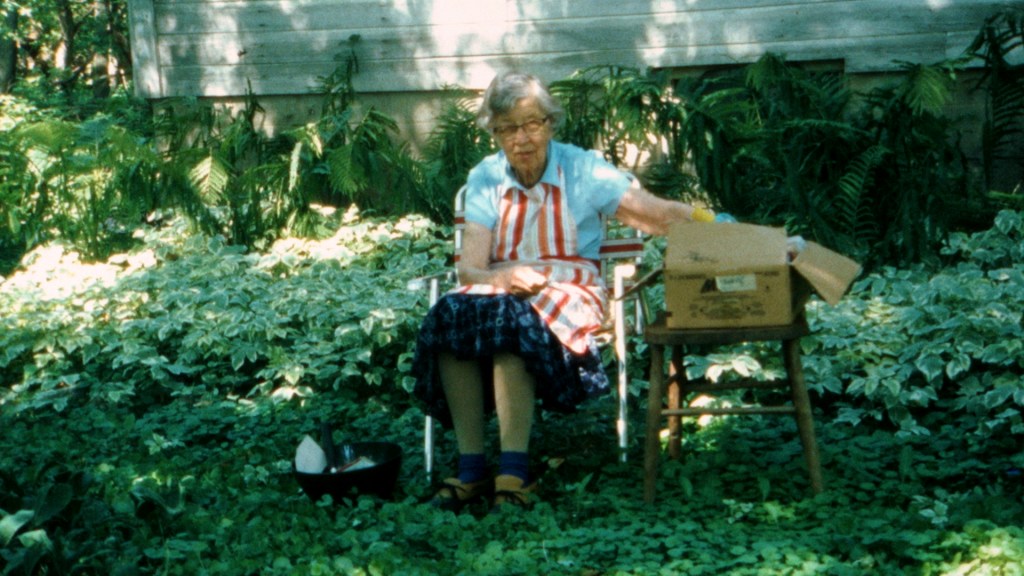
Agatha Bock is 90 years old and knows exactly how to plant watermelons, small ones and big ones and sometimes even giant ones. She knows when the soil is ready, which seeds to save, how to read the land she’s lived on her entire life. Her niece Amalie Atkins watched her do it. And over the last six years she and her team of only women shot some of Agatha’s secrets and habits on 16mm film, on a windup Bolex and an ArriSR2 studio camera (that might as well have been found in Agatha’s basement). AGATHA’S ALMANAC transports Agatha’s knowledge from her niece to us, the viewers, in what might be one of the most inspiring films about gardening and the question of what is important in life. There’s something quietly radical about that chain of transmission. Not a manual. Not an archive. A film that is not really telling a story but in the end tells so much more.
Fiercely independent Agatha lives alone on her ancestral farm – no car, no cell phone, no running water, not even a functioning landline. She plants and harvests entirely by hand, using seeds that have been passed down through generations, moving through her crop of berries, vegetables, beans, flowers and herbs with the kind of unhurried certainty that only comes from doing something your entire life. Her farmhouse looks grey and crooked from the outside and feels like the 1950s on the inside: unchanged, full of colour and texture and objects that have quietly outlasted entire eras. Neatly packed and labeled in small cartons and boxes. Atkins and cinematographer Rhayne Vermette shot the film with sensory sensitive viewers in mind, and you feel that in every frame. There’s a deliberate calm that reminds you that this pace existed before you forgot it. Agatha’s daily rituals don’t feel like a counterpoint to contemporary life. They feel like a rebuke.
Commoning is the word under which the International Women’s Film Festival Dortmund/Köln framed several events this year, or at least the thread that, accidentally or not, guided me through the festival. I had to look up the definition, because so far it hasn’t really made it into my theoretical and philosophical work in queer feminism. Probably because there is no real German word for it. To make sure we’re on the same page: Commoning is the social process of people collectively creating, managing and sharing resources [commons] through self-organized, collaborative, and sustainable practices. It acts as a counter-movement to market-driven private ownership, focusing instead on community-based, democratic, and collective care of shared resources.
Even if Agatha’s garden is her own – inherited, tended alone, visited only occasionally by family – I’d argue that the documentary itself has everything to do with communal knowledge sharing. Atkins doesn’t just observe her aunt. She opens her world to us. The garden, the seeds, the rituals: suddenly they belong to everyone who watches.
Silvia Federici (Re-enchanting the World, 2019, Caliban and the Witch, 2004) once said: „There can be no commons without community.“ In a talk with Athina Rachel Tsangari (THE HARVEST), they discussed how to create new forms of cooperation that include the nature and world around us. While they spoke at length about the importance of commoning, from everyday life to filmmaking as a practice, Federici also talked about the boom of urban gardening and community gardens.
Urban gardening has seen a surge in the past two decades. It starts, often enough, with something simple: a missing garden, a balcony, the desire for cheaper tomatoes than the ones at the supermarket. But community gardens are something else. They are the little oases where people meet not just to grow things but to talk, discuss, screen films, and build something collectively. Many of them don’t just practice gardening. They practice commoning. And no matter what kind of gardening one does, it needs knowledge passed down through generations: how to plant, harvest, preserve and cook. And maybe that’s the point. Gardening, and with it the reclaiming of land that capitalism has paved over, built on, stripped of wildlife and food, is a hyperfeminist practice. Not because of who does it, but because of how it works: collectively, through shared knowledge, through community spaces that become places of connection and alliance. In a world that wants us isolated and consuming, growing something together is an act of resistance. And maybe, in the process, we find a little of the quiet that Agatha never has to search for in her garden.
 COUNTERCUTS